Middle East Stereotypes – Culture and Politics

Tags

, , , , , , , , , , , , , , , ,

A man and his camelsStereotypes
In Western Society, one grows up in a world that is utterly alien and foreign to the Middle East. We develop our “knowledge” of foreign cultures through education at school and by the media. Whether it is on local news, or by watching a film about the Middle East, we build our perceptions on these images. The image of Bedouin wanderers, in their flowing robes, and a devotion to material items gives one the wrong impression of a more complex civilization. I grew up watching films like “Lawrence of Arabia,” and although I am not a fan of the “Sex and the City 2” film, I did see it. In these two films, one receives a misunderstanding of Middle Eastern culture. Women in various places on the Arabian Peninsula enjoy the same liberties and the same freedoms that women in the West do. Nor are all the men crazed extremist wanting to destroy buildings, planes, or people. However, in our minds, even though we are human beings, we still have great differences to overcome besides stereotypes.

Culture
Besides the stereotypes that have been growing in our minds about the Middle East, we also must consider their culture. The consensus of Middle Eastern culture by the West, is that it is still in the 19th century. However, that is not the case. With Mustafa Kemal and the role he played in the beginnings of the Turkish Republic, we can see that other Middle Eastern nations are also attempting to modernize their countries so that they may participate with Western society. At various times after World War I, various nations like Iran also modernized, even though it was through totalitarian means. However, as much as Middle Eastern countries try to modernize under democratic thought, I don’t think that it will work.

Politics in the Middle East are extremely complex and not as simple as many think. The various political structures in the Middle East can be broken down to a simple axiom that their culture ingrained into them for centuries, “I against my brother, my brothers and I against my cousins, then my cousins and I against strangers.” Throw in the ideals offered by Islam, over a thousand years of wars, including tribal wars, wars against the Turks, and wars against invading Crusaders, all building a defensive political mindset. Middle East politics is complex precisely because of the religious factor. When there are two divisions of faith, and divisions at tribal levels, it becomes difficult to arrive at a consensus at the national level. I think that if Middle Eastern countries could “get with the program” then all would be good in the world, however, that is not going to be the case. Although Islam, as taught by Mohammed was not a hateful religion toward other faiths such as Christianity, and Judaism, after 1000 years, hate still drives all sides. However, I still wish to remain hopeful that there is some common ground that we as human beings can come to and work together.

Philosophy Quiz

Here is a quiz I found online that I thought would be great for a brain/philosophical exercise. 

  1. Multiple Choice
  2. Short Answer
  3. Lab Practical

Section 1: Multiple Choice

1. On Russell’s theory of definite descriptions, “The present King of France is bald” is equivalent to

  1. Socrates is a man.
  2. Socrates is mortal.
  3. All swans are white.
  4. Anything follows from a contradiction.
  5. The cat is on the mat.

2. If I could do something besides take this exam, I would prefer to.

  1. Intuit an essence.
  2. Analyze a concept.
  3. Dissect a brain.
  4. Have a beer.
  5. A deconstruction of the concept of will shows the bankruptcy of the very notion of choice, so a fortiori of multiple choice.

Section 2: Short Answer

  1. Define reality. Give two (2) examples.
  2. Using only basic first order logic, develop a rational foundation from which to prove the truth of radical relativism.
  3. Analyze the fundamental nature of being. Introduce new distinctions and obfuscatory neologisms.
  4. Escape the hermeneutic circle with only fishing line and a Swiss Army knife.
  5. Demonstrate the validity of the fallacy of composition.
  6. Evaluate the following argument: “If conventionalism is true, it must be true by convention. We do not believe in conventionalism. Therefore, we should change our beliefs because conventionalism is self-evident.”
  7. Translate Heidegger’s Being and Time into Latin and Aramaic. Provide an analysis of the nature of translation which explains why neither translation makes sense.
  8. Assume solipsism to be correct. Explain why more people aren’t solipsists.
  9. Explain the Cartesian distinction between res cogitans and res extensa without going into any intentional states, e.g. thinking of Descartes.
  10. List three beliefs held by eliminative materialists.

Section 3: Lab Practical

  1. On the bench you will find a slave boy. Prompt him to remember the Pythagorean theorem.
  2. Next to the slave boy you will find a cave. Break free of your shackles, climb into the light, and behold the form of the Good. When you’re done, return to the cave and wisely rule your fellows.
  3. On the bench you will find the thing-in-itself. Treat it as a limiting conception and say nothing further about it.
  4. Next to the cave, you will find a brain in a vat. Determine its principles of operation. Determine what philosophical problems remain after you have done so. Write down several dozen of them.
  5. By staring at the brain, you will be provided with sense data. Arrange and combine them so that everything you know can be expressed in terms of them.
  6. Amidst the sense data you will find the Given. Debunk myths about it. Show its equivalence to the Taken-away.
  7. In addition to the beings on the bench, you will find Being as such. Use it to explain the difference between temporality and Temporality. Then use it to boil an egg.
  8. After having found Being you will find Nothing. Determine who this is presenting himself as Nothingness on the grounds of the nihilation of the bench.

Picasso says Moof! This test ©1998 by P.D. Magnus and Ryan Hickerson. You are encouraged to use it for nefarious, quasi-educational purposes.


Own Your Own Digital Identity

Tags

, , , , , , , , , ,

Facebook SecurityI am writing this post because of an incident I came across. A friend of mine just had a birthday recently. As usual, she received the typical “Happy Birthday” greetings on her Facebook. Most everyone’s wishes were all standard, except for one. A well-wisher actually mentioned my friend’s age. This breach of privacy and Internet etiquette upset her.  Continue reading

Culture Filters Perception

Tags

, , , , , , , , , , , , ,

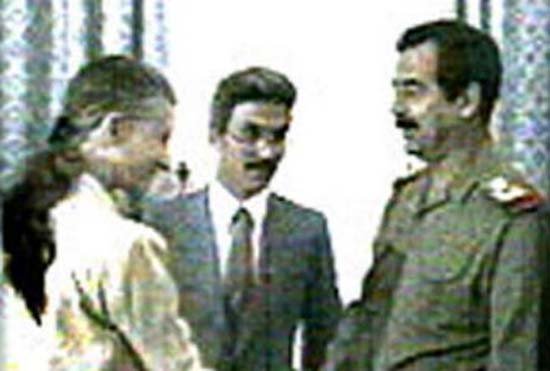
April Glaspie met with Saddam Hussein on July 25, 1990

April Glaspie shakes hands with Saddam Hussein

As my understanding of Middle East politics and history sharpened, I began to understand, the almost laughable conclusion that in 1990 Saddam Hussein “believed that he had U.S. approval to invade Kuwait.”  But carefully examining the situation, it seems almost plausible. One can sum up Saddam Hussein’s misconception of the consequences of the invasion of Kuwait with his Iraqi troops as, culture filters perception. Two groups of people, communicating with each other, using a common terms, but filtered and interpreted completely different. Certain events in the history of Middle East relations with the United States and specifically the person whom Saddam Hussein communicated with apparently led the Iraqi leader to feel that he had a free pass to invade Kuwait. Continue reading

The Middle East: Misconceptions Instilled by David Lean’s “Lawrence of Arabia”

Tags

, , , , , , , , ,

Lawrence of ArabiaWhen I heard that actor Peter O’Toole died last year on December 12, 2013, I was sad. Mr. O’Toole was nominated for an Academy Award for a film called “Lawrence of Arabia.” Although the film was loosely based on T.E. Lawrence’s accounts of his time in the Arabian Peninsula during World War I, it was director David Lean’s depiction of the peoples of that area, in contrast to what at the time we considered civilized people are like, that sets the tone for misconceptions about what living in the Middle East is like. In the film, Lean depicts the peoples as warring tribes too intent on fighting over watering holes, and on petty arguments between tribes, instead of fighting for their own independence from the Ottoman Turks. The film has Lawrence giving the concept of a unified Arab nation, of tribes united under a common flag, of similar peoples with similar beliefs, and similar culture could not even be fathomed by the Arabs themselves. He also shows the people as backwards and manipulated by the smarter Europeans, whose only concern is using the Arabs as a sideshow to distract the Turks from helping the Germans on either front during World War I. Continue reading